Motivated Reasoning and Confirmation Bias Drive Viral Claims of “Russian Bot” Declines
A viral chart showed that Ukraine’s strikes on Yandex silenced the company’s search crawler. But many people were ready (and willing) to believe it showed something more.

Over the last 72 hours, the Internet has been overwhelmed with reports of something miraculous: that “Russian social media activity” had dropped dramatically following Ukrainian drone strikes on Yandex data centers.
It is true that Ukrainian drones knocked out three of Yandex’s data centers, in a solid blow to Russia’s economy and information processing capacity — at Sasovo on October 8, Kaluga on October 9 and Vladimir on October 11.
But then people started sharing charts that alleged that Russian “bot traffic” had collapsed to almost nothing. The trolls on social media, they claimed, had finally been unplugged.
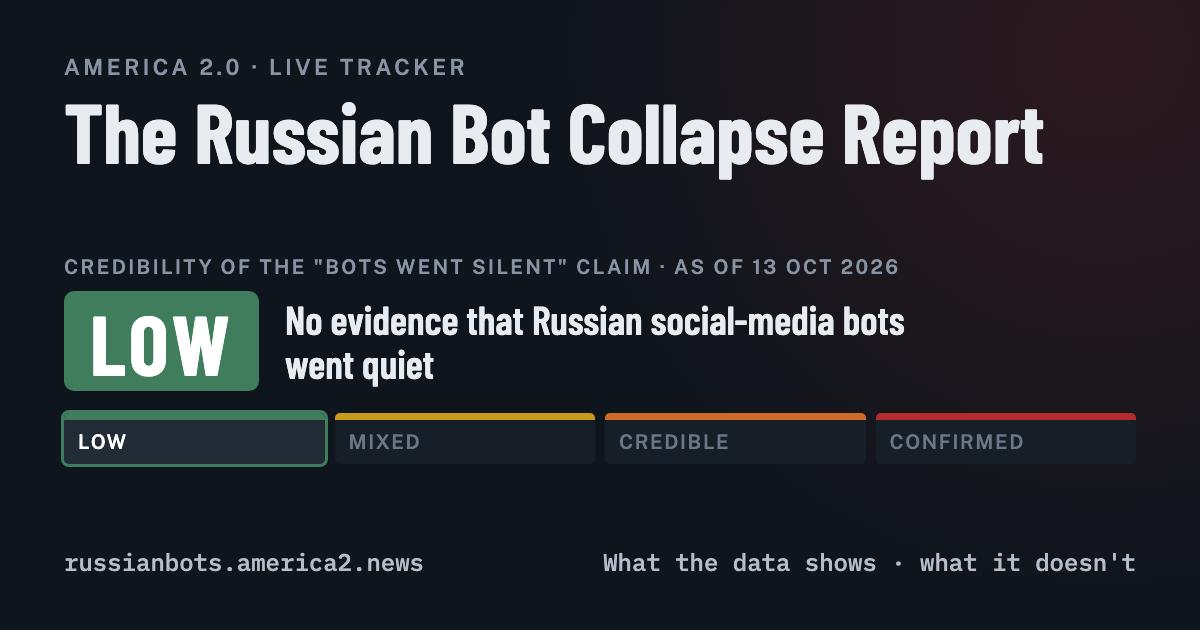
It was a great story. The only problem? It isn’t true — or at least there is no quantifiable evidence (yet) that supports the claim. As we did last week following reports of plague in Irkutsk (remember that?), we built a live tracker to sort out facts from fiction. And we’ve made every effort to test the claims beyond the vibes. Those efforts have, so far, failed to produce any claims or data that support the “Russian Bot Miracle of 2026.” Here’s what we did find.

What the charts actually measured
The viral chart came from Cloudflare Radar, and the numbers were real. But Cloudflare’s “bot” category counts automated web requests coming from Yandex’s own network, and almost all of that is YandexBot, the crawler Yandex uses to index the web for its search engine. When the data centers went dark, the crawler stopped crawling. Cloudflare itself told BBC Verify the drop was “not necessarily bot behaviour on social media platforms.”
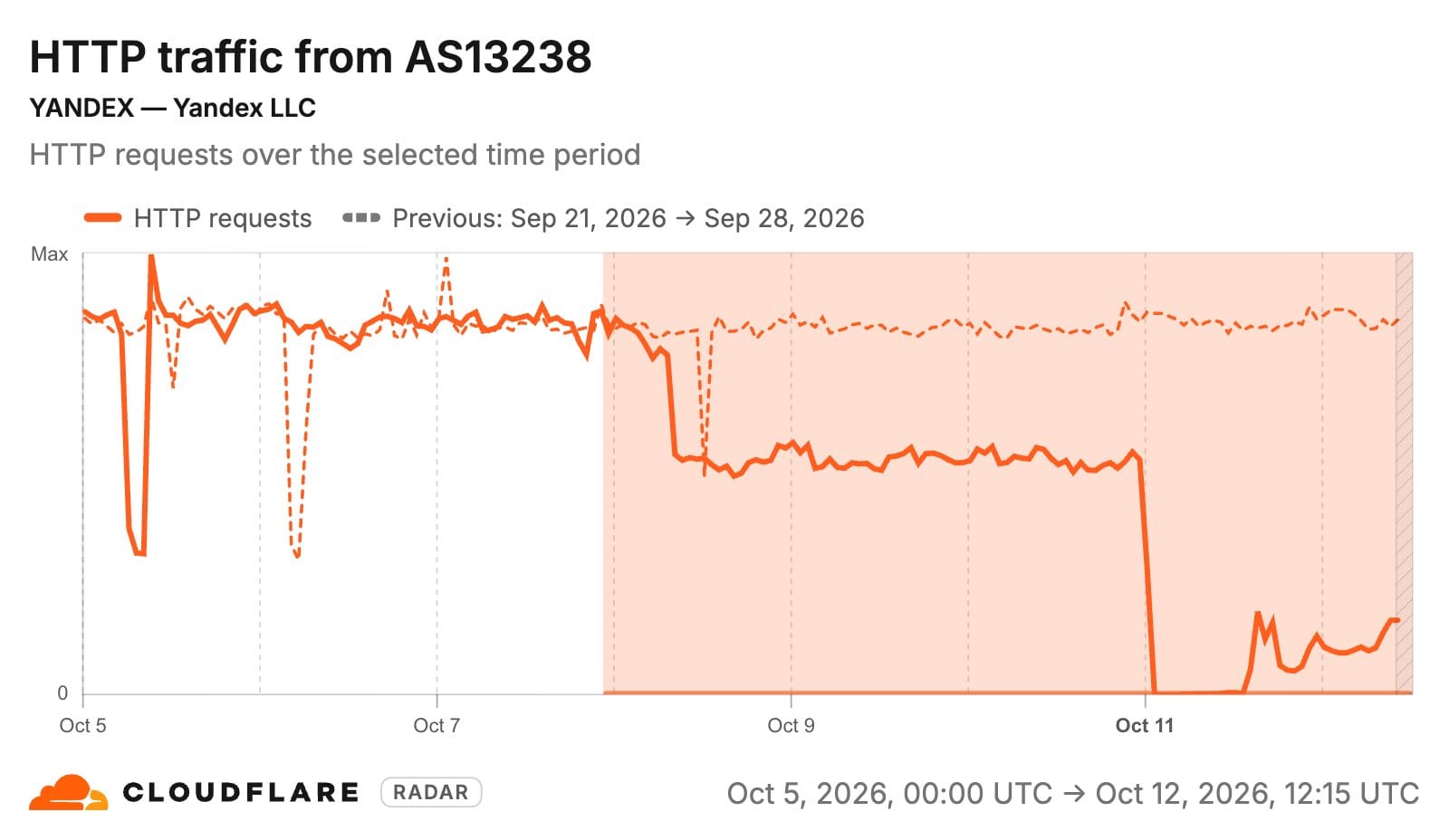
Tom’s Hardware ran the numbers under a headline saying Yandex’s bot traffic had been “nearly eliminated overnight” and told readers “the world is getting a break from Russian bots.” However, this was simply a misreading of the data, probably made in error, but by a publication that should know better.
Partly, there is a language problem: the word “bot” is overloaded. What people talk about when they are talking about coordinated inauthentic social media activity is probably better described by the word “troll.” Bots (automated programs, such as the crawlers that index the web for search engines) are a legitimate part of web infrastructure, and are a necessary part of search engine technology.
What the Russian troll networks actually show
Researchers who actually count Russian influence accounts (including America 2.0) saw no such thing. Res Futura, which follows about 500 pro-Russian accounts on Polish X, found normal activity through the strikes, and on October 13 the accounts’ hourly activity was up 45% on the day before.
The think tank Polisphere, watching nearly 10,000 accounts in German-speaking countries, found no statistically noticeable decline. Poland’s NASK found none either. Researchers at dTeam told BBC Verify they had seen no “traffic change from known Russian accounts and bot clusters on any platform,” and that the Storm-1516 and Matryoshka operations were still active.
There was one real signal, however. The automated “Pravda” news network, which floods the web with pro-Kremlin articles, lost about half its output for roughly 13 hours after the Vladimir strike, then recovered. This suggests it used a pipeline that leaned on something at Yandex, and quickly routed around it. Our tracker breaks all of this out network by network.
Why it spread anyway
This story (data centers hit; bots gone) was flawed from the start, and it was easy to see; the graphs shared (which also included a fake graph showing a drop in AfD traffic) were obviously misconstrued and were immediately debunked.
But what made the story travel was not evidence but psychology and an appetite for something people desperately wanted to be true.
After years of watching coordinated Russian campaigns poison political conversation, people wanted a win, and this one felt earned: Ukraine hits back, and the trolls go silent. Users reported quieter replies and ran “bot tests” under their own posts. It is an unscientific test with no control. But it felt true. Stephen Colbert coined a word for that: truthiness.
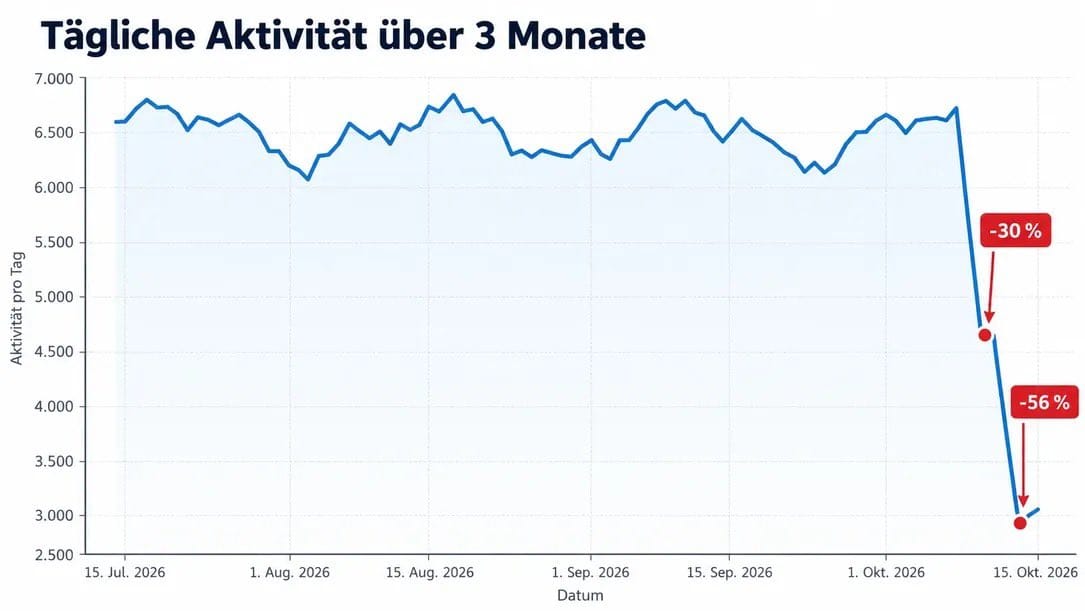
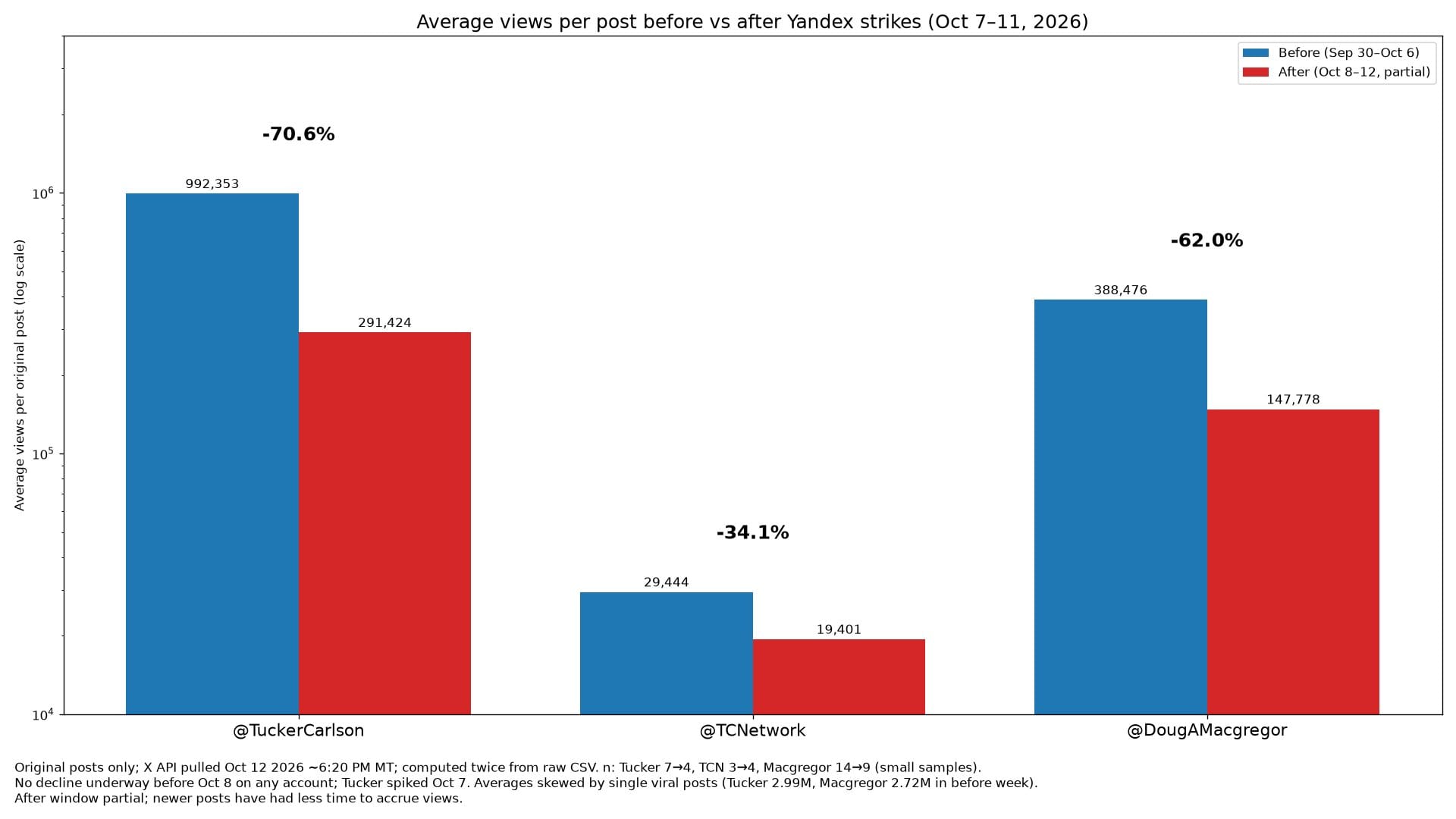
Charts made it look rigorous. A chart claiming that online support for Germany’s AfD had fallen 56% turned out to be completely fabricated; one of its biggest spreaders, Polish analyst Jarosław Wolski, retracted it. One widely shared chart said Tucker Carlson’s average views had fallen 71%; its own footnote admitted it compared seven posts with four, and that the newer posts “have had less time to accrue views.” But footnotes go unread when the headline seems to support an already-held conclusion.
Officials joined in. On Monday, Ukrainian President Volodymyr Zelensky said it had suddenly become “a little easier to breathe” on social media because there were “fewer bots.” Tomasz Siemoniak, Poland’s minister coordinating the intelligence services, said Poland’s Internal Security Agency had seen “a significant, radical drop” in Russian bot activity. Lithuania’s prime minister, Mindaugas Sinkevičius, said allies should ask Zelensky “to strike more data centres in Russia, and that might help.” Rep. Sarah McBride (D-Del.) joked, “Was a Russian data center just destroyed or are you just happy to see me?” But none of them cited any data; their assertions were anecdotal or unsupported.
This is a clear example of motivated reasoning: starting from the conclusion we want and then weighing evidence by whether it gets us there, waving through what reinforces the conclusion and picking apart what doesn’t. And its close cousin, confirmation bias, plays a supporting role.
Once we expect something, we notice what fits and overlook what doesn’t. Primed to expect quieter replies, people found them; the troll still sitting in the next thread simply didn’t register. Researchers have even measured this: in one study, experienced Twitter users rated accounts they disagreed with as more bot-like than ones they agreed with, whether or not the accounts were bots. Believing your opponents aren’t real is a comfortable belief. Both are common human failings, not partisan ones. They are also exactly the vulnerability influence operations are built to exploit. A false story that flatters its audience spreads faster than a true one that doesn’t.
Studies of Russian social media influence operations suggest that they run on a heterogeneous, globally distributed network of piece-workers using a variety of tools and directives. Constraints on operating influence networks from inside Russia itself have helped to drive this structure, which has made the entire ecosystem more resilient.
If, as people would like to believe, they were concentrated on a single company’s server infrastructure, they would have been blocked long ago. It is precisely their global distribution that makes Russia-directed information operations such a difficult, ongoing, and pernicious threat.
The retractions have started
A wave of corrections is now underway. Polish defense analyst Jarosław Wolski, whose “AfD support fell 56%” post drew tens of thousands of likes, apologized and deleted it. Commentator Michał Fiszer walked his claims back within hours. Czech MEP Tomáš Zdechovský, whose post was viewed more than four million times, now says he “did not present it as a clear fact,” though it remains pinned to his profile. And Zelensky’s office told BBC Verify he had been “talking about the atmosphere on social media” rather than a fall in bot activity. Fact-checks from BBC Verify, Euronews, The Verge, RFE/RL and others reached the same conclusion. The tracker keeps a running list of retractions and corrections.
Newsrooms are still catching up. Yesterday, we spoke with the Kyiv Independent, and like many outlets, they were working to report accurately on a story that’s moving faster than any supporting evidence.
Why it matters
The strikes did real damage to Russia’s digital economy, and that is the actual story. An entire range of Yandex services is down and will take months if not years to restore. But the credibility of people who study and counter Russian influence is at risk when we embrace a claim because it feels good. Moscow benefits when its critics are seen to believe things that aren’t true.
The tracker currently rates the claim LOW, lists exactly what would change that rating, and updates as new data comes in. If someone produces real quantifiable evidence, we will update our assessment accordingly. ◼
Additional Selected Reading
Virginia Heffernan Richard Irvine-Brown
 Richard Lawler