Live Tracking the Real Risks to the 2026 Midterms
American election processes are under pressure, but the guardrails are holding — so far. We built a live tracker to separate documented actions from online chatter.
Four weeks out from Election Day, many Americans are asking some version of the same question: will the 2026 midterms be stolen, cancelled, or turn violent? It’s a fair question. This year the federal government has taken unusual steps aimed at how Americans vote and count. But with an avalanche of information online, much of it designed to spark outrage or fear, many readers end up doomscrolling, leading to anxiety and an unclear picture.
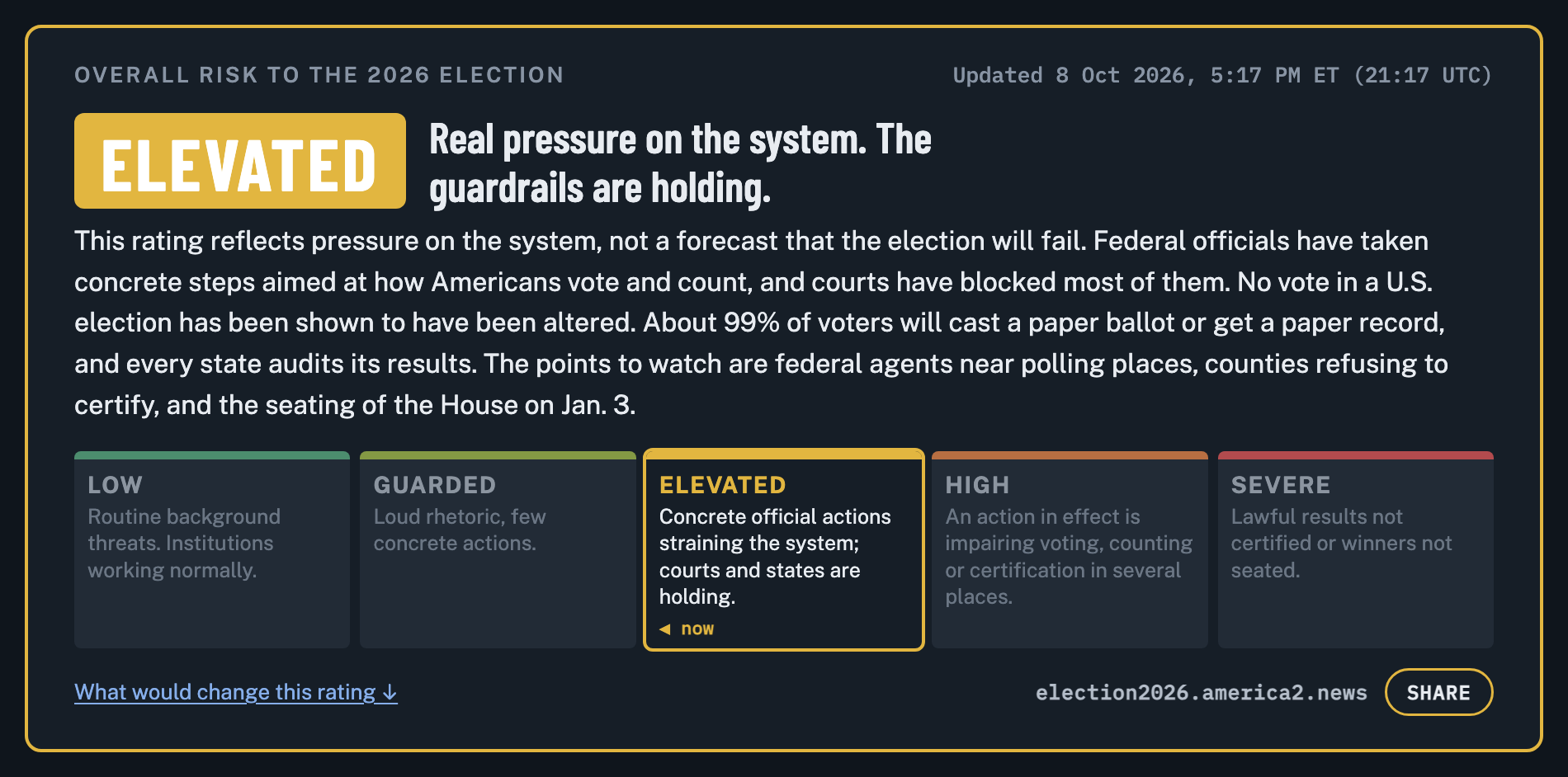
So we built a live tracker, the America 2.0 Election 2026 Risk Report. It follows the real pressures on the midterms from Election Day on November 3 through counting, certification, and the seating of the new Congress on January 3, 2027. Its job is simple: separate what has actually happened from what people say might happen. We won’t play risks down, and we won’t play them up.

How it works
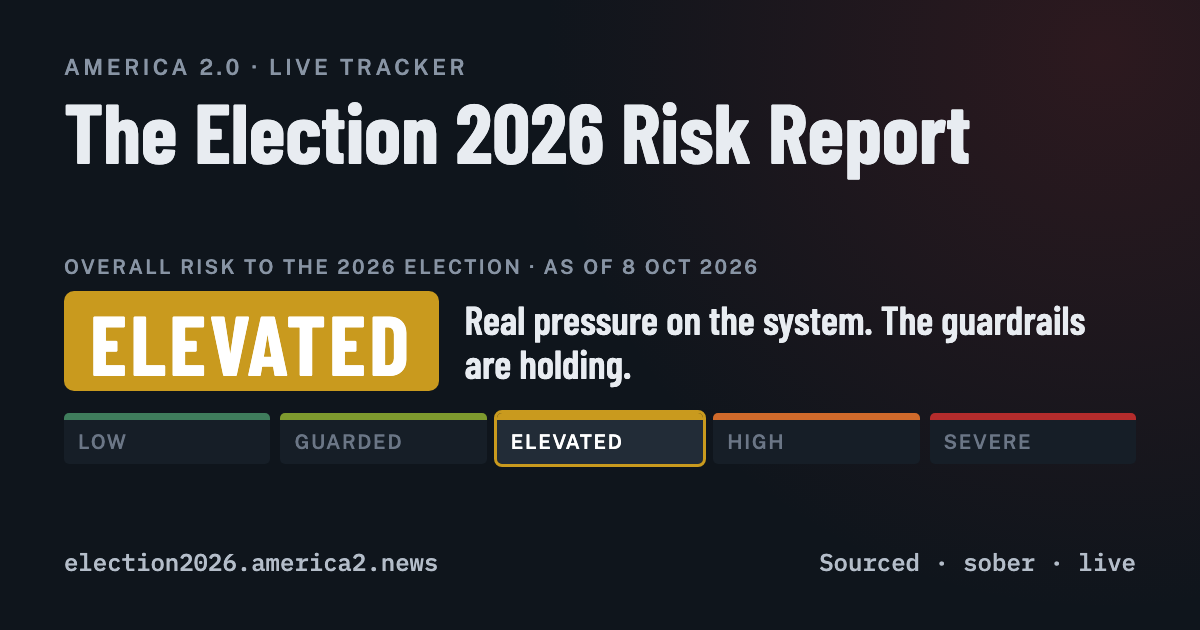
At the top is an overall rating on a five-step scale: Low, Guarded, Elevated, High, and Severe. Each step is defined by what would have to be true, not by how worried anyone feels. “Guarded” means loud rhetoric with few concrete actions. “High” means an action actually in effect is impairing voting, counting, or certification in several places. “Severe” means lawful results aren’t certified or winners aren’t seated.
Below that, we break the election into the specific risks people raise, from “Chinese” voting machines to troops at polling places to a refusal to seat winners in January, and rate each one by how far the evidence goes: Chatter (talk without a credible source), Credible concern, Action taken, Blocked (action taken, but stopped in court for now), and Material impact.
Every risk card says plainly what would move it up or down. We also sort them into “hard” risks (physical force: troops, armed agents, seizures, violence) and “soft” ones (lawsuits, executive orders, pressure on officials, and shaping what people believe about the results).
The tracker includes a “Claims in circulation” table that checks the most-shared claims, from all sides, against the record; a list of specific tripwires that would change our rating; key dates; and what the major forecasters project. We don’t make our own forecast, but expected margins matter: a close result is easier to contest.
The tracker is monitored around the clock. Our software watches major news outlets and official sources and adds new headlines to a “Latest reports” feed, each labelled by whether it has been checked. The rating itself changes only after human editorial review, and only based on credible, named sourcing. Every claim on the page links to its source — 140 of them so far.
Where things stand: Elevated
Our current rating is Elevated: real pressure on the system, with the guardrails holding. That’s a judgment about pressure, not a forecast that the election will fail.
Why isn’t our rating lower? Because the threats are real, and more than rhetoric. Two executive orders tried to add proof-of-citizenship rules and restrict which mail ballots the Postal Service carries. The Justice Department has sued 30 states and D.C. for their full voter files. Homeland Security Secretary Markwayne Mullin’s August 24 letter about China-made parts in voting machines tied full federal security grants to hand counts of paper ballots. Internal records show that Homeland Security Investigations, part of ICE, ingested roughly 99 million voter-related records.
In January the FBI seized about 700 boxes of Fulton County, Ga.’s 2020 ballots and records under a search warrant. Asked about the Insurrection Act and emergency powers, Trump said “I don’t rule anything out or in.”
Meanwhile, the federal teams that once warned states and the public about foreign threats have been cut back: the FBI’s Foreign Influence Task Force was disbanded, CISA has lost about a third of its staff, and the Election Assistance Commission has had no commissioners since July.
Why isn’t our rating higher? The system is holding. Courts have blocked both executive orders, and the Supreme Court declined to let the mail-ballot rule take effect before November. A federal judge vacated the hand-count grant condition on September 28. Courts have dismissed 26 of the Justice Department’s voter-file suits. Early and mail voting are under way in most states, and no troops or armed agents have been ordered to polling places. The chairman of the Joint Chiefs has said there are no plans to put them there. And no vote in a U.S. election has ever been shown to have been altered.
Why the system is hard to break
This point gets lost, so it bears repeating: American elections are hard to break. They run in more than 10,000 separate jurisdictions, on different equipment under different rules. About 99% of voters will cast a paper ballot or get a paper record that can be recounted by hand. Every state now has a post-election audit law. Only Congress can change Election Day; the president can’t postpone it. To change an outcome, someone would have to defeat several of these safeguards at once, in many places, without being noticed.
That doesn’t mean nothing can go wrong, but it means the real risks are narrower, and different, than much of the online conversation suggests.
Bloodshed, or a bent reality?
The question we hear most is whether this turns violent, or whether the damage comes through law, paperwork, and propaganda. We assess that the main risk to this election is a bending of reality, not bloodshed. Nearly every documented action this year has been “soft”: lawsuits, orders, data demands, and claims of fraud aimed at shaping what Americans believe about the results and laying groundwork to contest them.
Trump’s October 4 post complaining about slow counts (claiming that Detroit, Philadelphia, and California “take weeks to Rig”) is a preview. Counting mail ballots legitimately takes days in many states, by law, and slow counts will be described as “fraud.” We expect this to intensify between now and January 3.
Hard risks are real, but narrower, and probably come later. This year, federal force has been threatened, and sometimes used, against protests, not at polling places. So the most dangerous window is probably not Election Day itself but the weeks after, if a disputed count brings people into the streets and officials describe those protests as insurrection or terrorism. A September 2025 presidential memorandum, NSPM-7, has already built machinery for investigating “organized political violence” as terrorism. We have not seen it used in an election context, and we’re watching for it.
The pressure points we’re watching most closely are federal agents near polling places, county officials who refuse to certify, and the seating of the House on January 3, 2027. Forecasters broadly expect Democrats to win the House, and see the Senate as competitive. When the party holding executive power is projected to lose a chamber, federal actions on machines, voter rolls, monitors, and emergency powers matter more.
The same standard for everyone
We hold claims from every direction to the same standard. On the page you’ll find right-coded claims, such as that DHS “disqualified” voting machines or that federal investigators found Venezuelan code, checked against the record alongside left-coded ones, such as that 2024 was secretly hacked or that Elon Musk could flip votes with Starlink’s “lasers in space.”
We also track failures that aren’t attacks at all. In Texas, a vendor software error left hundreds of thousands of voter registrations unsent to counties until September. Breakdowns like that can cost people their vote, and they can be recast as evidence of fraud.
Some claims are simply wrong: there is no legal path for a president to cancel or postpone the midterms. Others are real and documented but less consequential than they sound. Musk’s America PAC had spent $26.7 million on 2026 races as of October 6. That spending is legal and public, and it aims at persuading voters, not at the count.
Help us watch
The tracker will keep updating through the seating of Congress in January. If you see something worrying, email editor@america2.news with the subject “2026 Election Security” and a link to where you saw it. We’ll check it against credible sources and incorporate it into our analysis, whether it holds up or is a rumor that needs debunking.
Please bookmark the tracker and share it with anyone who is anxious, or certain, about what’s coming. Level-headed analysis based on well-sourced information is one of the guardrails, too. ◼
Also: Bookmark Our Irkutsk Plague Tracker