Part Six: Epstein and the (Dangerous) Game of Evolution
Was Jeffrey Epstein part of Russia's broader war on the West? In this multi-part series we examine his obsession with nuclear scientists, eugenics, transhumanism, and influence. What we found will likely surprise you.

“Jordan said it first, but Thor's the one that suggested we call the thing Game B,” Jim Rutt told me in his apartment in rural Staunton, Virginia. I had driven to visit him in September, 2025 to discuss Game B, a speculative design for a new kind of society he helped initiate in 2012, and which has taken on a life of its own in recent years.
Rutt, a likable, retired technology executive and now a podcaster, rose to prominence as CEO of Network Solutions, a darling of the dot-com wave. If you registered a .com, .net, or .org domain name in the 1990's, it was through Network Solutions. After Network Solutions was acquired by Verisign in 2000, Rutt was looking to do something new.
In 2001, the New York Times published a story titled “Internet ‘Bad Boy’ Takes on a New Challenge,” describing Rutt's both sometimes brash personality and his foray into what he called “complex adaptive systems.” Put another way, these are systems defined by simple rules that can lead to complex behavior and sometimes unexpected emergent properties. As he told the Times, then aged 47, “This is some deep stuff. It comes down to some serious questions about the nature of reality and being. It's about how everything works.”
Rutt began modeling various kinds of systems using simple computer programs that could run on PC's of the era; he studied the work of complexity scientists Stuart A. Kauffman and John Holland. This interest led Rutt to the Santa Fe Institute (SFI), where Kauffman was based. Rutt became a Researcher in Residence from 2002 to 2004, and then chairman of the board from 2009 to 2012.
The Santa Fe Institute had, for years, an association with Robert Maxwell, his daughter Christine, and later, with Jeffrey Epstein. (See Part 1 in this series.) As we reported previously, Robert Maxwell gave a $100,000 grant to the Santa Fe Institute specifically to support the “integrative aspects of complex systems.” Indeed, it was the work of Stuart Kauffman, Rutt's mentor, (who was SFI faculty in residence from 1986 to 1997) that Maxwell specifically intended to support.
On Epstein and SFI
Because of Rutt's longtime association with SFI, we tackled the obvious questions about Epstein's influence there head first. Had Rutt ever met Epstein? No. Was he aware of his donations? Yes. On whether he knew Epstein had a ranch in New Mexico? “Frankly, I didn't even know he had a ranch till a year or two ago,” Rutt told me. Who did Epstein know well at SFI? Murray Gell-Mann. Epstein gave him about $25,000 per year for several years.
Rutt said of Gell-Mann, downplaying the possibility that he was interested in sex, “I have no idea about the hookers or the whores, but I don't think so. That's not really Murray's taste. He'd be more for the fine dining, good wine, good steak, and the good life, right? He loved the good life and he enjoyed... he knew how to enjoy life.”
Rutt added, “The other thing I would say, having looked at Epstein in science from multiple perspectives, is that Epstein had amazing taste in science. He backed good people and good institutions and vectored money to worthy and important scientific goals. So that's something that's always important to consider. When you think about Epstein and his money in science, it was not going to trashy projects.”
Indeed, Epstein made efforts to network further with SFI's top scientists, but was met with resistance. According to Rutt, Epstein's official influence at SFI was ultimately limited to his relationship with Murray Gell-Mann. And Rutt had no knowledge about Christina Maxwell, Ghislaine's sister, who had been added to the board in exchange for Robert's 1990 grant. “Christina who?,” Rutt quipped. “Gone by my time.”
A Life of Its Own: Game B
While at SFI, Rutt became immersed in the world of complexity science, surrounded by luminaries in the field. This led him in 2012 to write a paper on a new design for the US monetary system, which he thought might have other downstream implications.
Rutt sent his paper to SFI board member Jordan Hall (then known as Jordan Greenhall), the developer of the DivX video encoding format. Hall suggested adding his friend Bret Weinstein, an evolutionary biologist, to the discussion. “He was the third atom in the molecule, essentially,” Rutt told me.
Continuing his thought about Weinstein, “He was also the guy who first formulated... have you run across the concept of the egregore?,” referring to an esoteric concept used to describe a collective thought-form that takes on a life of its own. “I was actually going to bring it up with you,” I replied.
I was familiar with the idea of an ‘egregore’ as it pertains to memetics, and the propagation of ideas through culture. Weinstein saw societal change through exactly this evolutionary biology lens: whatever systems were most beneficial to society, he thought, might ultimately be adopted. What was necessary were more competitive designs.
Building on these core concepts, Rutt gathered a group of thinkers in Staunton in 2013. While each brought their own ideas, Rutt said, “Everybody agreed that central banking, managed fractional reserve banking, was bad, and it needed to be replaced. My 2012 sixty-five page paper, which became affectionately or not so affectionately known as the tome, laid out a precursor to dividend money, and everybody agreed on that.” From then on, such unanimous agreement would not be so easy to find.

The initial focus was on the formation of a new political party, which they dubbed the “Emancipation Party.” However, they found that while this idea appealed to older people, it did not at all to younger generations, who felt sure it had to be a scam — especially because a focus was on paying dues for party membership.
So the group shifted focus, convening over the course of 2013, meeting every six weeks or so, in sessions that became known as Staunton I through V. The goal? To build a win-win design for society that actually had a shot of taking hold.
According to Rutt, Jordan Hall coined the terms Game A (representing the status quo) and Game B, representing their new design. Where Game A described the bad, old, zero-sum ways, Game B would describe new, better, positive-sum ways of thinking that would benefit everyone. Over time, with no other terminology having arisen to describe these two concepts, Thor Muller, a technology entrepreneur, suggested that Game B become the official name of the project. It stuck.
Of course, actually talking about Game B was fraught with hazards; as it didn't yet exist and was perpetually a work in progress, it carried a characteristic of all utopian schemes — a concern to not saddle it with the baggage and verbiage of the old ways. As Jordan Hall put it, “Game B is notoriously difficult to think and talk about for the very good reason that if you were using the conceptual structures that came out of Game A to do so, you may very well be poisoning the well.”
During the course of the 2013 Staunton meetings, the group devolved into two factions: one that wanted to focus on systems design, and another interested in personal growth and increased individual consciousness as pathways to global change. Neither side was terribly interested in the other's approach.
Stemming from this impasse, Rutt decided to put the project on ice and called off plans for a Staunton VI meeting in August 2013. In January 2014, the project went into spore mode, as Rutt describes it, and he figured that various participants would pick up aspects of the project at a later time.
The San Diego Interpretation
In 2014, Jordan Hall and Daniel Schmachtenberger (the internet philosopher raised in the Maharishi International University we met in the last installment of this series) founded Neurohacker Collective, a company focused on developing and selling dietary supplements intended to improve cognitive function. Today the company, now known as Qualia Life Sciences, sells its pricey supplements through a variety of outlets worldwide.
Bret Weinstein launched a revival of interest in the Game B concepts with an appearance on the Joe Rogan Experience podcast in December 2017. Schmachtenberger and Hall also joined in, riding the wave of renewed interest. In 2018 they launched The Emergence Project which was ostensibly focused on Game B concepts such as “omni-considerate systems.” This later morphed into The Consilience Project, with Hall handling “Strategic Intelligence.”

Together, Schmachtenberger and Hall, along with new collaborators Jamie Wheal (founder of the Flow Genome Project) and Forrest Landry (a philosopher and advisor to Qualia), formed what Rutt and Bret Weinstein would later call the “San Diego interpretation of Game B.”
And while Rutt is deeply allergic to “woo,” preferring instead hard-nosed scientific thinking, and Bret Weinstein continued to see the project through his preferred lens of evolutionary biology, Schmachtenberger leaned more towards the spiritual, personal development approach identified in the early Staunton gatherings.
The San Diego crew became more closely associated with the “integral” philosophy of Ken Wilber (A Theory of Everything, 2000). And in the last year, Jordan Hall has become a Christian fundamentalist, syncretically incorporating those ideas into his Game B thinking. To put it mildly, Rutt found this puzzling. “He knows damn well my view of religion,” Rutt said, “but he's still the same Jordan.”
Unity 2020 and the Intellectual Dark Web
Bret Weinstein took the Game B ideas in another direction and launched his own presidential ticket, Unity 2020, featuring Rep. Tulsi Gabbard and Rep. Dan Crenshaw as a “bipartisan” ticket to oppose both Joe Biden and Donald Trump.
 Anthony L. Fisher
None of this made much sense, considering that Gabbard and Crenshaw had already endorsed other candidates, and it wasn't entirely clear that Weinstein had even consulted with them about running on the Unity 2020 ticket — much less together. Weinstein, it seemed, wished to flex the so-called “Intellectual Dark Web” influence he was cultivating with his brother Eric (who also had some influence on Game B discussions, and is a managing director at Peter Thiel's investment firm, Thiel Capital.)

By September 2024, Bret Weinstein turned up again with Tulsi Gabbard, this time spearheading the “Rally to Rescue the Republic,” in Washington, D.C. Having covered this event first hand, I can say that it was a who's who of MAGA, MAHA, and Russia apologists, featuring such Russia-aligned luminaries as Jordan B. Peterson, Russell Brand, Robert F. Kennedy, Jr., Jack Posobiec, Lara Logan, Rob Schneider, Matt Taibbi, Jimmy Dore, and several others too stupefyingly dull to mention. Whatever Weinstein thought he was doing in 2020, by 2024 he was fully in the MAGA/MAHA camp. As he told The Spetctator, “This will be ‘an event’ in the same way that Woodstock was ‘a music festival.’ I truly believe that.”
On Monarchy
As Rutt and I began to wrap up our long discussion, I mentioned to him that I had actually interviewed Daniel Schmachtenberger way back in October 2022. I was familiar with some of his work then, and had questions. Among them was how it came to be that Schmachtenberger had been invited to join a group called the Orthodox Order of St. John, Russian Grand Priory.
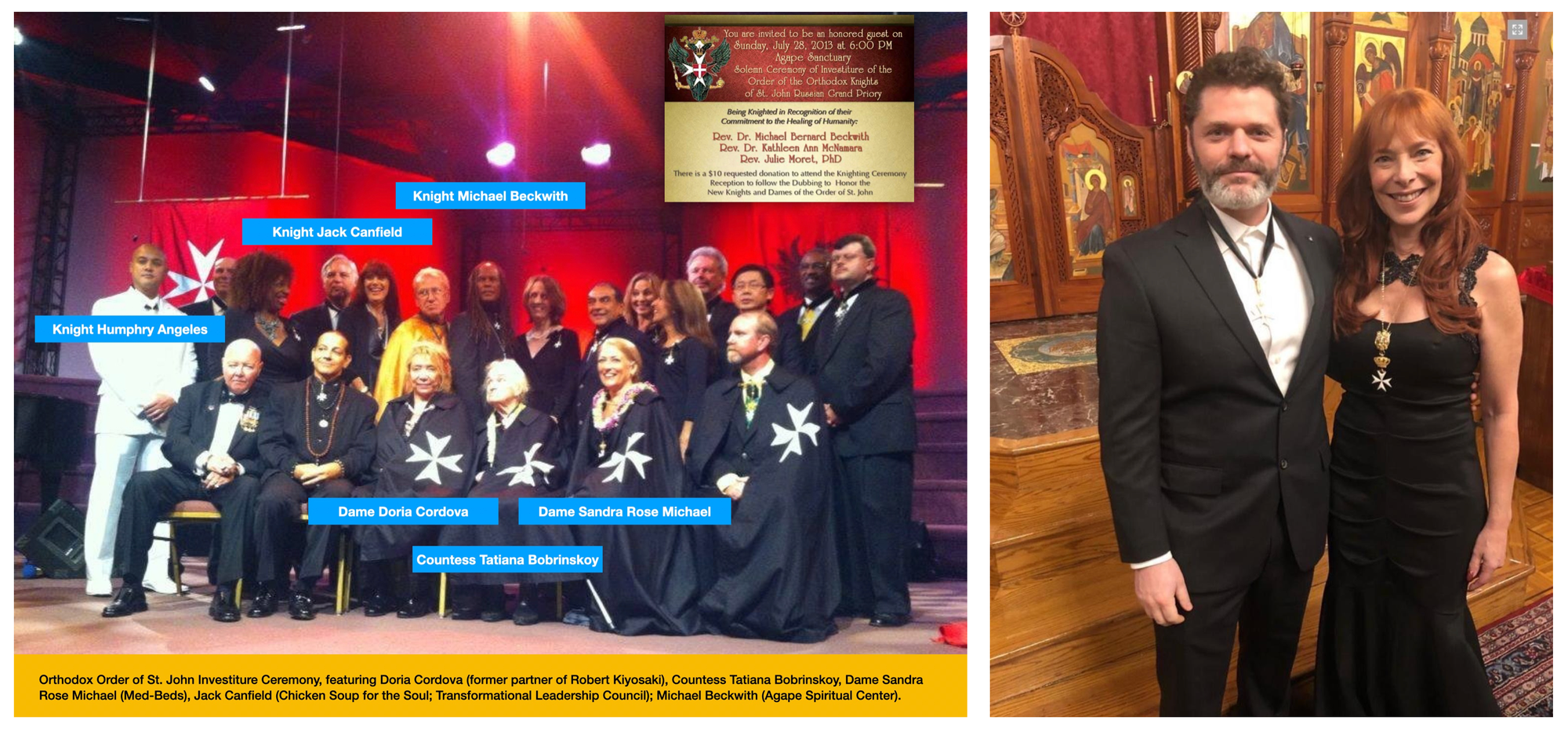
Countess Tatiana Bobrinskoy (leader of the group for decades, and a self-proclaimed descendant of Ivan the Terrible) told The New York Times in 1985, “We're noted for our wild parties, but nobility is an obligation and we have done wonderful things.” The Times continued, “Founded in 1938, the association says it is dedicated to the preservation of Russian history, genealogy and culture, and to helping impoverished Russian nobility.”
When I asked Rutt why Schmachtenberger might have joined such an organization, he paused for a moment and said, “One time Daniel mentioned... that monarchy wasn't necessarily an insane way to govern. Didn't say anything more than that.” I shot him a puzzled look. “And I never pursued it. And he never pursued it,” he added.
When I asked Daniel himself about this back in 2022, he said, “Well, some people there asked me if I would come get involved and I said I would check it out because I was interested to see the Order of St. John, the Hospitallers that started in the 10th century, doing charity for the poor and taking care of them. I was like, that sounds nice. Yeah, they did a good thing. And I wanted to see if they still had any real capacity as an organization that had some kind of morals or wisdom associated. And it was very clear that it was just the remnants of a dying lineage, where the Romanov family that had given it sovereignty was no longer in real Russian power.”
He added, “In order to be there, you have to go do some basic charity stuff. And so it's not bad. There's nothing bad happening there, there's just nothing particularly important happening there.”
However, the group also had some associations with Barbara Marx Hubbard, the godmother of “conscious evolution” who called Daniel her “evolutionary son.” Los Angeles-based spiritual guru Michael Beckwith was knighted in 2013, as was “Chicken Soup for the Soul” author Jack Canfield had been some years before. Both are close Hubbard allies. Hubbard was also very close to Epstein pal Deepak Chopra (as shown in recent email releases), and he called her “the voice of conscious evolution in our time.”
Another OOSJ member, Dame Dr. Sandra Rose Michael, became known for selling $120,000 “med-bed” type devices and speaking at new-agey conferences filled with QAnon-linked speakers. And Knight Humphry Angeles, a mysterious young man from Northern California, traveled to Manila in 2016 with another QAnon influencer, Lisa Clapier.
Choosing to join this group, which was by any reasonable reading primarily dedicated to the glorification and restoration of the Romanov dynasty, is quite unusual.
The Networked Egregore
One reason to visit Rutt in person was to sort out just who knows whom in this complex web. It's clear that Santa Fe Institute is one nexus of influence that includes Epstein, Jordan Hall, and Rutt. However it's not clear Epstein had any direct influence on Rutt — and it should be noted that Rutt is a strong advocate for Ukraine.
It also seems that Schmachtenberger never knew Epstein, though Epstein had been aware of the Maharishi world in which he was raised. Schmachtenberger and Rutt have both collaborated directly with Bret Weinstein. Epstein knew Chopra but not Hubbard. Thiel knows Eric Weinstein and met Epstein, but hadn't met the others. One has the sense that whatever ideas were bouncing around between these unlikely collaborators, they had perhaps gotten out of control, spinning out into something not entirely intentional.
At one point I asked Rutt, “So here you are, and there's other people, Jordan and Daniel designing Game B, and putting this egregore out into the wild. What ethical responsibility do you bear for the results of that?”
He answered firmly, “We own it.”
“But suppose that it goes some direction that you don't want it to go,” I replied.
Rutt said, “My answer would be, I did the best I could.” ◼
• Part One: Just what was Jeffrey Epstein doing in Santa Fe?
• Part Two: Jeffrey Epstein, John Brockman, and the Third Culture
• Part Three: What was Epstein's “Edge” agenda?
• Part Four: Making Sense of Epstein's Russia Ties
• Part Five: Epstein, Iowa, and the Maharishi
Our story continues in the next installment.
Additional Suggested Reading
 Inkoh G. Nito
 Christine Lin
 Will Sommer
 Anthony L. FisherJim Rutt
Watch “The Story of Game B, with Bret Weinstein & Jim Rutt” video by Rebel Wisdom (David Fuller and Alexander Beiner).